
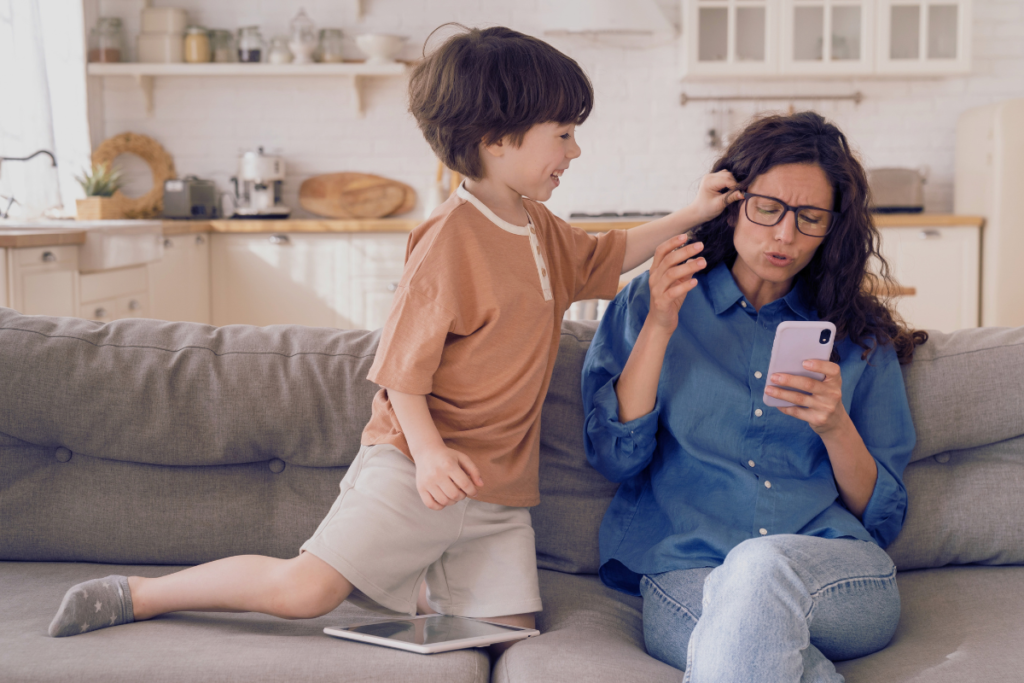
There is something slightly strange about the world children are growing up in today.
Technology is everywhere. We use it to work, communicate, navigate, organise our lives and, increasingly, to fill every little gap in between. A five minute wait in a queue feels long enough to reach for a phone. Friends meet for dinner and sit around the same table while each person looks at their own screen. Parents watch their children at swimming lessons or sport with a phone in their hand instead of their eyes on the activity. Sometimes, a baby is being gently rocked in a swing while the adult beside them is completely absorbed in a screen.
And perhaps the problem isn’t the technology itself. It’s the constant need to be connected to something else.
Children don’t just learn from what adults tell them. They learn from what they repeatedly see. If every quiet moment is filled with a screen, if boredom is immediately interrupted and if adults rarely seem comfortable simply doing nothing, what are children learning about how to be in the world?
They need something different, too. They need to play in the mud, run barefoot at the beach, collect sticks, climb, build, make a mess and spend twenty minutes doing something that appears completely pointless to an adult.
They need to help cook, water the plants, fold the washing and participate in the ordinary tasks of family life.
They need to wait. They need to be bored. They need moments where nobody is entertaining them and nothing is being recorded.
Not every experience needs to become a photo or a video. Not every outing needs to be documented. Sometimes a picnic can simply be a picnic, a walk can simply be a walk, and a child can simply be allowed to play without an adult reaching for a phone to capture it.
And perhaps most importantly, children need to experience adults who are genuinely present.
That doesn’t mean being available every second of every day. Parents are human, and sometimes the phone is how they work, organise life or simply get five minutes to themselves. But there is something powerful about occasionally putting it away and giving a child the experience of having their parent’s full attention, watching the entire swimming lesson, sitting on the floor and playing without checking a notification, or simply having dinner without a phone beside the plate.
We don’t need to raise children who reject technology. We need to raise children who know that life exists beyond it.
Children who can tolerate boredom, find their own ways to play and notice the world around them, being comfortable simply existing in it.
Perhaps protecting childhood in an increasingly connected world isn’t about building bigger walls around technology, but making sure there is still plenty of life worth looking up for.
Because long before children learn how to use technology, they are learning something much more important: how to be human.